
Marine Cargo Insurance in Australia: From Supplier to Final Delivery
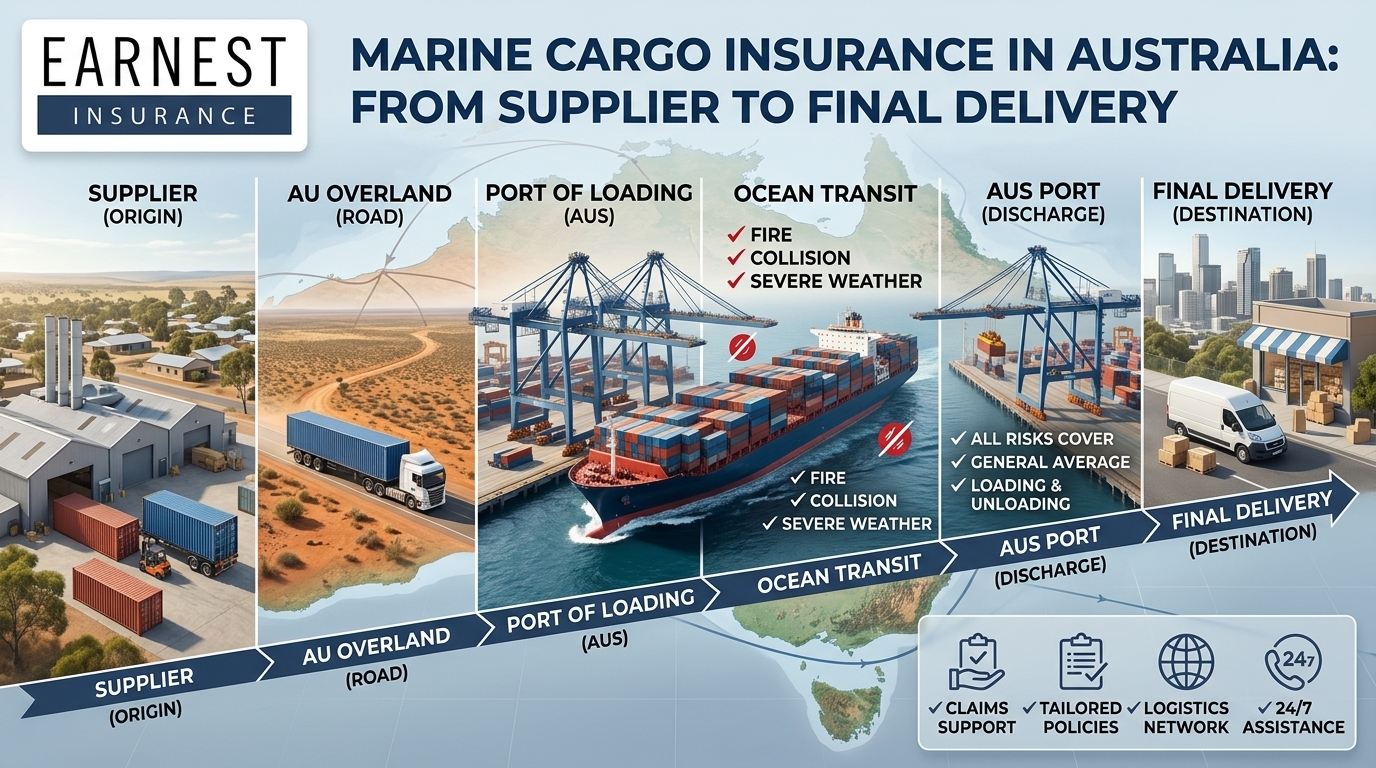
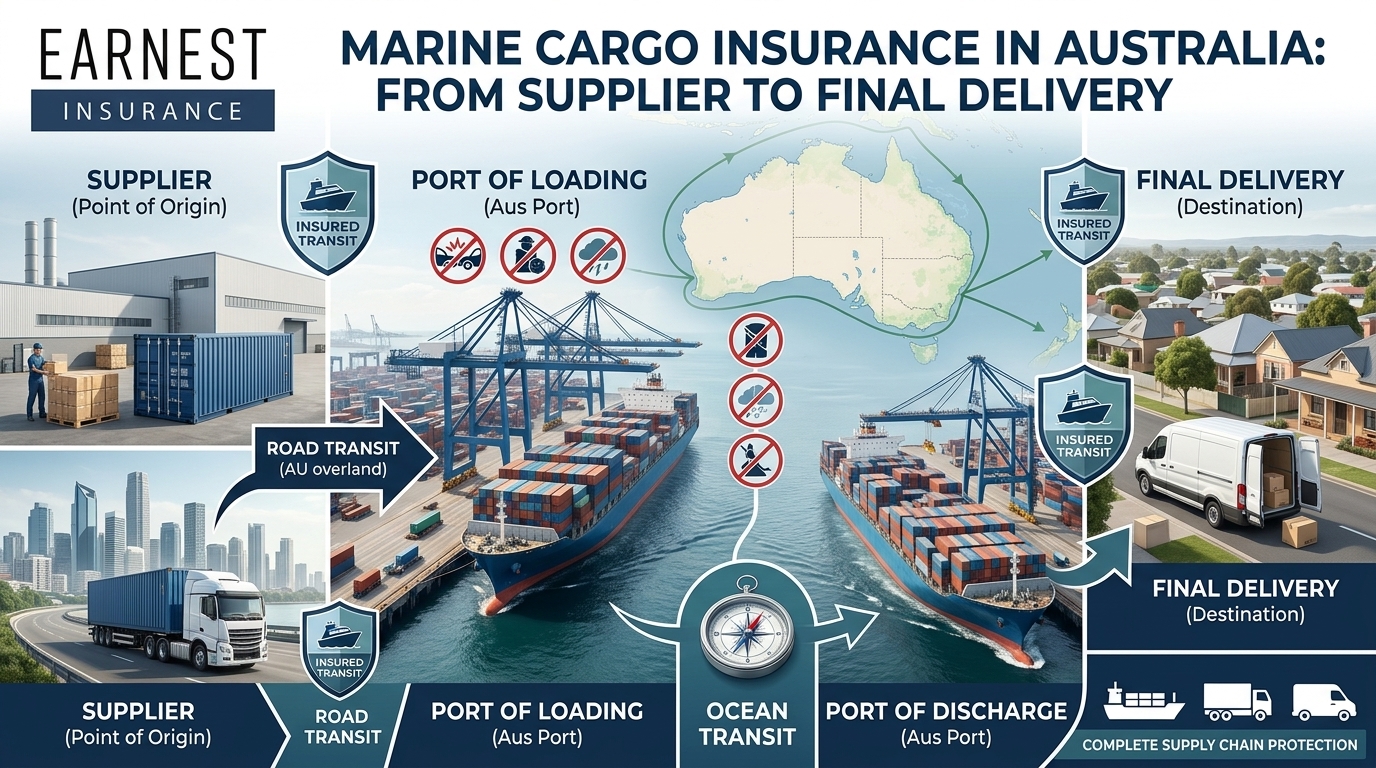
Introduction: Protecting Your Goods Throughout the Shipping Journey
Importing or exporting goods involves more than arranging a freight company and paying for shipping. Products may travel through multiple warehouses, ports, vessels, aircraft and road transport networks before reaching their destination. Every handover introduces potential risks, from accidental damage and theft to lost containers and unexpected handling incidents.
Marine cargo insurance helps businesses manage the financial risk of loss of or damage to insured goods during covered transit. Depending on the policy, protection may extend across international shipping, domestic road or rail transport, air freight, and certain temporary storage periods associated with the journey.
For Australian importers, exporters, manufacturers, wholesalers and logistics businesses, the important question is whether the policy covers the goods, route and transport stages involved in their actual operations.
For example, a Melbourne-based importer may have goods insured during the international sea voyage but need to confirm that the subsequent road journey to its warehouse is also covered. An Australian exporter might discover that insurance arranged by an overseas buyer offers a narrower level of protection than expected.
These are reasons to examine the details of a marine cargo insurance policy before the goods leave the supplier.
Earnest Insurance helps Australian businesses explore marine insurance options suited to their operations. This guide explains how cargo insurance works, the available levels of coverage, common exclusions and practical steps to review your shipping arrangements.
What Is Marine Cargo Insurance?
Marine cargo insurance is a type of insurance designed to protect an insured party's financial interest in goods while they are being transported under an insured journey.
Despite the word marine, coverage is not necessarily limited to ships. Depending on the policy, goods may be insured while travelling by sea, air, road or rail, including specified connecting transport and temporary storage.
Businesses that may benefit from considering marine cargo insurance include:
- Australian importers receiving products from overseas suppliers.
- Exporters sending manufactured goods to international customers.
- Wholesalers distributing stock between locations.
- Manufacturers shipping raw materials, components and finished products.
- Retailers importing furniture, clothing, electronics or other merchandise.
- Businesses transporting machinery, commercial equipment or specialised cargo.
The precise protection depends on the policy wording, insured values, selected clauses, exclusions and conditions.
Marine cargo insurance also differs from insurance for a vessel itself. Hull insurance generally concerns the vessel and its insured equipment, while cargo insurance concerns the goods being transported. Separate marine liability arrangements may be relevant to other risks associated with shipping operations.
For Australian businesses moving products through international supply chains, identifying these distinctions is an important step towards arranging suitable coverage.
What Does Marine Cargo Insurance Cover?
The answer depends on the policy selected. Marine cargo insurance can provide protection against specified physical loss or damage to insured goods while they are within the covered transit.
Potentially covered events may include accidental damage during transportation, specified water damage, certain theft losses, fire and other insured incidents. Whether any particular event is covered depends on the terms that apply to the shipment.
Common areas to review include the following.
1. Physical loss or damage during transit
Goods may be damaged when a container shifts, a package is dropped during handling or cargo is affected by an insured transportation incident.
The policy will determine whether the particular event falls within the insured risks and whether any exclusions or conditions apply.
For instance, a business importing commercial machinery should confirm that both the nature of the equipment and the handling arrangements are consistent with the insurance provided.
2. Sea, air and connecting road transport
A shipment may involve several different transport methods. Goods could leave a supplier by truck, travel by ship to Australia and then continue by road to a distribution centre.
Some marine cargo insurance arrangements cover the complete specified journey, including connecting transport. Others may restrict the journey, locations or circumstances covered.
Do not assume that protection automatically continues from the supplier's warehouse to your own premises. Confirm the start and end points of the insured transit.
3. Loading, unloading and handling
Loading and unloading can expose goods to impact, crushing, dropping and other physical damage.
Review whether these activities fall within the selected cover and whether any conditions apply to particular cargo types or handling procedures.
This is especially relevant for fragile goods, industrial equipment and products that require specialist handling.
4. General average and salvage expenses
International shipping can involve expenses that are less obvious than direct physical damage.
Under the maritime principle of general average, certain sacrifices or extraordinary expenditures made deliberately for the common safety of a maritime venture may be shared among the interests involved, subject to the applicable rules.
A cargo owner may therefore face a contribution or need to provide security before goods are released following a serious incident. Marine cargo insurance commonly addresses general average and salvage under relevant policy terms, but businesses should confirm the specific protection available.
For more information about this issue, see Zurich Australia's marine insurance FAQs.
5. Specified temporary storage
Goods sometimes remain at a port, distribution facility or other storage location while awaiting the next stage of transportation.
Some policies provide for temporary storage associated with an insured journey. This should not be confused with unrestricted cover for goods held in a warehouse for an extended period.
Confirm how the policy treats storage, delays, consolidation facilities and final delivery arrangements.
Understanding the Different Levels of Cargo Insurance Coverage
One of the most important decisions when arranging marine cargo insurance is selecting a level of cover suitable for the goods and their transportation risks.
Cargo policies may use the Institute Cargo Clauses, including Clauses A, B and C. These represent different approaches to insuring cargo and should not be treated as interchangeable.
Institute Cargo Clause A
Clause A generally provides the broadest of these three standard cargo clause options for accidental physical loss or damage, subject to applicable exclusions and conditions.
This may be worth considering for valuable finished products, electronics, machinery or goods that pass through several handling stages.
However, the term all risks can be misleading if understood to mean that every possible commercial loss is covered. Clause A still has exclusions, and the exact policy wording matters.
Institute Cargo Clause B
Clause B covers a more restricted range of specified events than Clause A.
Depending on the applicable wording, these can include certain major transportation incidents and other listed perils. It does not automatically offer the same breadth of protection as Clause A.
Businesses should examine the events insured and consider whether the restrictions are appropriate for the type of goods and route involved.
Institute Cargo Clause C
Clause C provides a more limited selection of insured events than Clauses A and B.
It can be suitable in some circumstances, but it should not be chosen solely because the premium is lower. A narrower policy may leave particular handling or damage scenarios outside the cover.
The International Chamber of Commerce's Incoterms 2020 guidance also highlights an important distinction: CIF ordinarily requires the seller to arrange a lower minimum level of cargo insurance under Clause C or equivalent terms, while CIP requires a higher level under Clause A or equivalent terms.
These are contractual minimums, not recommendations that the minimum is necessarily sufficient for every shipment.
Before choosing a policy, compare the risks associated with the actual cargo, the selected clause, the exclusions and any optional extensions.
Who Is Responsible for Insuring Goods During International Shipping?
Understanding who should arrange marine cargo insurance can be complicated when the buyer, seller, freight forwarder and carrier are different parties.
The starting point is the sales contract and the agreed Incoterms rule.
Incoterms, published by the International Chamber of Commerce, clarify responsibilities for transport, costs, delivery and the transfer of risk between buyers and sellers. They do not replace the insurance contract itself.
CIF and CIP: What Australian Importers Should Know
Two commonly discussed terms are CIF and CIP.
CIF means Cost, Insurance and Freight. It is intended for sea and inland waterway transport. Under Incoterms 2020, the seller arranges and pays for transportation and insurance to the named destination port, while risk generally transfers to the buyer when the goods are loaded on board the vessel at the shipment port.
CIP means Carriage and Insurance Paid To. It can apply to different transport modes, including multimodal shipments. The seller arranges and pays for carriage and insurance to the agreed destination, but risk generally transfers when the goods are handed over to the contracted carrier.
The distinction matters because the party paying for freight and insurance is not necessarily the party bearing the risk throughout the journey.
For example, an Australian company buying machinery under a CIF contract should not automatically assume that the seller's insurance includes broad protection against every form of accidental damage or theft.
The buyer should obtain the insurance certificate or relevant policy information and establish what protection is actually provided. Additional cover may be appropriate depending on the goods, route and contractual responsibilities.
For complex transactions, obtain professional advice on how the sales contract, Incoterms and insurance arrangements interact.
Common Marine Cargo Insurance Exclusions
Marine cargo insurance can provide valuable financial protection, but no policy should be assumed to cover every loss.
Understanding exclusions before a shipment begins can help businesses identify risks that need additional protection or better risk-management procedures.
Common exclusions or restrictions, depending on the policy, may concern the following.
Inadequate packaging: Goods can be vulnerable when packaging is unsuitable for their weight, fragility, stacking requirements or transport conditions. Some policies exclude damage resulting from packing or preparation for transit that does not meet applicable requirements.
Ordinary wear and tear: Normal deterioration is generally treated differently from accidental physical damage caused by an insured event.
Inherent vice: This refers to loss arising from the natural characteristics of the goods themselves, rather than an external insured event. Perishable products can present particular issues.
Delay and consequential losses: A delayed shipment may create lost sales, missed deadlines or contractual penalties. These commercial losses are not automatically insured merely because the goods are covered for physical damage.
Mechanical or electrical breakdown: The failure of equipment or goods without an insured external event may be excluded, depending on the policy.
War and strikes: Certain war, strike and related risks may require specific clauses or extensions and remain subject to exclusions.
Unexplained shortages: A discrepancy between shipping records and delivered quantities does not automatically establish an insured loss. Documentation and the relevant policy terms are important.
These examples are not a complete list. Exclusions vary by insurer, cargo type and policy.
Businesses should examine the actual wording rather than rely on general descriptions of marine cargo insurance.
How Much Marine Cargo Insurance Do You Need?
The appropriate insured amount depends on the goods, their valuation, the applicable contractual terms and the policy's basis of settlement.
Choosing an amount that merely reflects the supplier's invoice may not always capture every cost relevant to the insured value.
Businesses should establish how the policy treats freight charges, duties, other expenses and any agreed uplift or valuation basis.
A practical example
Imagine an Australian distributor imports commercial equipment valued at $80,000. The business also pays international freight, insurance and other import-related costs.
If the equipment is damaged during an insured incident, the amount payable will depend on the applicable policy terms, insured value, excess, exclusions and the assessment of the loss.
The business should therefore confirm the valuation method before the shipment begins rather than assume the invoice price automatically determines the insurance settlement.
Australian importers should also distinguish insurance valuation from customs valuation and the calculation of import GST. The Australian Border Force's guidance on the cost of importing goods explains how transport and insurance costs can be relevant to the value of taxable importations.
For larger or more complex shipments, professional advice can help establish an appropriate valuation and limit.
Annual Policy or Single-Transit Cover?
Businesses that ship goods regularly may have different insurance needs from those arranging an occasional shipment.
Annual marine cargo insurance
An annual arrangement may be appropriate for businesses with repeated shipments throughout the year. Depending on its terms, it may simplify administration by covering declared or otherwise eligible transits within an agreed period.
The business must still comply with the policy's requirements, including declarations, reporting obligations, eligible cargo categories and any limits for individual shipments or accumulated stock.
Single-transit insurance
Single-transit cover is designed for an individual shipment or specified journey.
It may suit a business arranging an occasional import, moving a valuable item or undertaking a one-off commercial transaction.
The choice depends on shipment frequency, cargo values, business activities, available products and the terms offered by the insurer. A broker can help compare the practical differences.
How to Reduce Cargo Risks Before Your Shipment Leaves
Insurance is only one part of a sound shipping process. Better preparation can also reduce the likelihood of damage, disputes and delays.
Before dispatch, consider these practical steps.
Use suitable packaging. Select packaging that reflects the goods' weight, fragility, stacking requirements and expected handling conditions.
Keep accurate shipping documents. Retain commercial invoices, packing lists, transport documents, purchase contracts and relevant correspondence.
Check the route. Make sure the proposed transit, transfer points, destination and any storage arrangements match the insurance information supplied.
Confirm declared values. Check that shipment values and relevant details are accurate and that any declaration obligations are satisfied.
Photograph cargo where appropriate. Records of the goods and their packaging before dispatch can help establish their condition.
Communicate requirements to suppliers and freight partners. Confirm packaging, handling and notification arrangements before goods are released.
Understand the claims process. Know whom to notify, the evidence to preserve and any deadlines that may apply.
These measures are useful for both regular importers and businesses arranging occasional shipments.
What Should You Do if Your Cargo Is Damaged?
If goods arrive damaged, missing or apparently affected by an insured incident, take reasonable steps to protect the goods and document what has happened.
A practical response generally includes the following actions:
- Notify the relevant carrier, freight forwarder and insurer or broker promptly, following the applicable reporting requirements.
- Photograph visible damage and retain packaging where practical.
- Record discrepancies between the shipment documents and the goods received.
- Preserve invoices, packing lists, delivery records and relevant communications.
- Follow the policy's claims instructions and cooperate with requests for evidence or inspection.
Avoid discarding damaged items or arranging extensive disposal before checking whether the insurer requires an inspection, unless urgent action is necessary to protect people or prevent further loss.
The policy and the circumstances of the incident determine whether a claim is accepted and what settlement may be available.
Choosing Marine Cargo Insurance in Australia
Australian businesses comparing marine cargo insurance should look beyond premium alone. The important consideration is whether the policy addresses the risks associated with their specific goods, transport arrangements and commercial responsibilities.
Useful questions to ask include:
- Does the cover extend across the entire journey, including relevant road or rail connections?
- Which cargo clause or insured events apply?
- Are storage, loading and unloading included where required?
- Are war, strikes or other specialist risks relevant to the shipment?
- How is the insured value calculated?
- What excesses, limits, exclusions and conditions apply?
- Is annual cover or single-transit insurance more suitable?
- What documentation is required if a claim occurs?
Businesses should also consider whether marine cargo insurance forms part of a wider risk-management plan involving commercial property, stock, liability and road transport.
For example, an importer receiving goods at a warehouse may need marine cargo insurance for the shipment, while a distribution business may separately require suitable truck insurance for its vehicles. These policies protect different interests and should be assessed accordingly.
Finding marine cargo insurance through Earnest Insurance
Businesses looking for marine cargo insurance in Melbourne or elsewhere in Australia can review their requirements with Earnest Insurance.
Earnest's marine insurance service provides information about available options for cargo, vessels and related maritime operations. Its brokers compare insurance options and policy features to help businesses assess cover suited to their operations.
You can learn more through the Earnest Insurance Marine Insurance page or call 1300 402 412 to discuss your requirements.
Before deciding, request and read the relevant policy wording and disclosure documents. Confirm the cover, insured values, exclusions and conditions applicable to the shipment.
Frequently Asked Questions About Marine Cargo Insurance
What does marine cargo insurance cover in Australia?
Marine cargo insurance may cover specified physical loss or damage to goods during an insured transit, including sea, air and connecting land transport where included. Cover depends on the policy, selected clauses, exclusions and conditions.
Does marine cargo insurance cover goods transported by road?
Some marine cargo policies include specified road transport as part of an international or domestic journey. The insured route and policy wording determine whether the particular movement is covered. Do not assume all domestic deliveries or storage periods are included.
What is the difference between marine cargo insurance and goods-in-transit insurance?
Marine cargo insurance often relates to international shipping and associated transport, while goods-in-transit insurance commonly addresses domestic movement of goods. Their scope can overlap, and products vary. Check the policy wording rather than relying on the product name alone.
Is cargo insurance mandatory in Australia?
Whether insurance is required depends on the contract, applicable arrangements and the particular transaction. Incoterms such as CIF and CIP include seller insurance obligations, while other terms may not require either party to purchase insurance under that rule. Businesses should evaluate their exposure even when insurance is not contractually required.
Does CIF mean the buyer is fully insured?
No. CIF requires the seller to arrange a specified minimum level of cargo insurance under Incoterms 2020. A buyer may need to verify the certificate and policy terms and consider additional cover if the protection is insufficient.
Can marine cargo insurance cover high-value machinery?
Some policies may cover machinery and other high-value goods, subject to insurer acceptance, valuation, packaging requirements, limits and exclusions. Provide accurate details about the cargo and handling arrangements when requesting a quote.
How can I obtain a marine cargo insurance quote?
Prepare details of the goods, shipment value, origin, destination, transport methods, shipment frequency and relevant sales contract. Earnest Insurance can be contacted through its marine insurance service page or by calling 1300 402 412 to discuss available options.
Conclusion: Protect Your Shipment Before It Starts Moving
International trade brings opportunities for Australian businesses, but every shipment can involve financial risks. Goods may pass through several transport stages, handling facilities and different contractual arrangements before arriving at their destination.
Marine cargo insurance helps businesses manage specified risks of physical loss or damage to insured goods during covered transit. The quality of the protection depends on the policy selected, the shipment details, the valuation basis and the exclusions and conditions that apply.
Before your next shipment leaves the supplier, confirm who bears the risk, who has arranged the insurance, what level of cover applies and whether the complete journey is included.
For help reviewing your options, visit Earnest Insurance or contact the team on 1300 402 412.
General information only: This article does not take into account your objectives, financial situation or needs. Insurance availability, terms, conditions, exclusions and limits vary by insurer and policy. Read the applicable policy wording and disclosure documents and consider whether the insurance is appropriate for your circumstances before making a decision.
Subscribe to our newsletter
Related posts
More Blog Posts
Marine Cargo Insurance in Australia: From Supplier to Final Delivery

Is Your Business Properly Insured? 10 Insurance Gaps Australian Businesses Should Check Before Renewal


How to Choose the Right Business, Construction, Truck, Bus and Marine Cargo Insurance in Australia


How to Choose the Right Business, Construction, Truck, Bus and Marine Cargo Insurance in Australia


How Much Is Public Liability Insurance in Melbourne? A 2026 Guide for Businesses


Business Insurance Broker Melbourne: How to Choose the Right Cover for Your Business


Business Insurance Broker Melbourne: How to Choose the Right Cover for Your Business

Insurance Broker Melbourne: How to Choose the Right Insurance Broker in 2026

Truck Insurance Quote in 2026: How Telematics and AI Safety Technology Are Changing Truck Insurance in Melbourne


Truck Insurance Quote in 2026: What Melbourne Truck Operators Need to Know


Truck Insurance Quote: A Complete Guide to Truck Insurance in Melborune Australia
Bushfire & Climate Risk Insurance in Victoria: What Melbourne Businesses Should Review

Construction Insurance in Australia: What Every Builder, Tradie & Contractor Needs to Know


Cleaning Business Insurance Australia: Public Liability, Tools & Equipment Cover
A General Guide to Cargo & Marine Insurance

Types of Business Insurance: Liability & Directors Cover | Earnest Insurance

Sole Trader Public Liability Insurance | Costs & Cover

Everything You Need to Know About Small Truck Insurance

🏢 Commercial Property Insurance: What It Covers

Cafe & Coffee Shop Insurance

Insurance For Coffee Shops

Building & Construction Insurance Essentials


What you need to consider if you have a licensed venue

Insurance for the transport and logistics sector


What is really inside Business insurance?

Get in Touch
Have questions about insurance? Our expert brokers are here to help.